
Building Institutional Vigilance and Accountability for Business and Human Rights in Ghana’s Extractive Sector (BIVA)
BIVA is a 12-month project implemented by A Rocha Ghana (ARG) in partnership with the Commission on Human Rights and Administrative Justice (CHRAJ) and the National Commission for Civic Education (NCCE).
The project seeks to strengthen accountability for business and human rights within Ghana’s extractive sector by improving the documentation of violations, strengthening institutional responsiveness, raising public awareness and supporting affected communities to engage with accountability mechanisms.
Project Context
Ghana’s extractive sector contributes significantly to the national economy and provides livelihoods for many people. However, mining activities—particularly illegal and irresponsible mining—continue to create significant risks for communities, human rights and the environment.
Communities in mining-affected areas may experience displacement, inadequate compensation, loss of livelihoods, pollution-related health concerns and exploitation of vulnerable groups, including through child and forced labour.
These challenges are compounded by environmental degradation. The contamination of water bodies by substances such as mercury and cyanide, deforestation and the degradation of agricultural land can undermine both community wellbeing and livelihoods.
Despite these concerns, affected communities often face difficulties documenting violations, accessing appropriate accountability mechanisms and securing effective redress.
Ghana’s National Action Plan on Business and Human Rights, adopted in 2025, provides an important framework for addressing business-related human rights concerns. BIVA seeks to contribute to this broader effort by strengthening the connection between community experiences, credible evidence and institutional action.
Objectives
- Strengthen the documentation and evidence base on business and human rights violations associated with extractive activities.
- Improve institutional vigilance and responsiveness to documented human rights and environmental concerns.
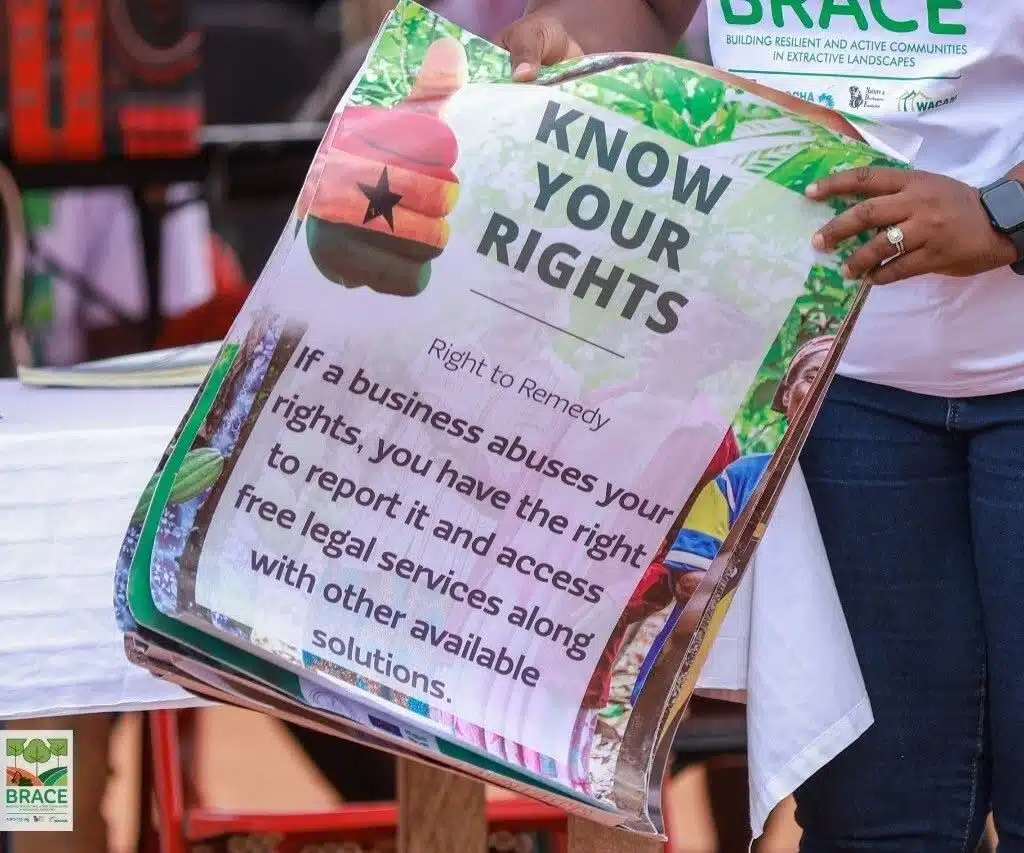
- Support affected communities to better understand and engage with available accountability and redress mechanisms.
- Increase public awareness and dialogue around business and human rights within the extractive sector.
- Promote greater accountability and responsible business practices among relevant actors in the extractive sector.
Key Components
- Evidence Gathering and Documentation
The project will undertake field-level documentation across the Eastern, Western, Western North, Ashanti and Central Regions.
Community experiences and reported violations will be documented and analysed to establish credible evidence of human rights, business and environmental concerns.
Where appropriate, documented cases will be developed into case dossiers and briefing materials that can support institutional engagement and follow-up.
2. Institutional Engagement and Accountability
BIVA will work closely with CHRAJ and NCCE to strengthen the link between community-level evidence and institutional response.
The project will engage relevant institutions and stakeholders to encourage greater vigilance, follow-up and action on documented cases while exploring opportunities to strengthen existing accountability mechanisms.
3. Community Sensitisation and Engagement
Affected communities will be engaged to increase awareness of business and human rights, civic responsibilities, available accountability mechanisms and avenues for redress.
The project will support communities to better understand how their experiences can be documented and communicated through appropriate channels.
4. Media and Public Awareness
BIVA will use media engagement, press briefings and public communication to bring greater visibility to business and human rights concerns within Ghana’s extractive sector.
The project will seek to ensure that credible evidence and community experiences contribute to informed public discussion and greater demand for accountability.
5. Stakeholder Dialogue
The project will bring together relevant actors—including state institutions, communities, civil society, media and other stakeholders—to discuss documented concerns, institutional responsibilities and opportunities for stronger accountability.
A key platform will be the National Mining and Human Rights Dialogue, which will provide an opportunity to reflect on findings and promote collective action.
Geographic Focus
BIVA will be implemented in selected mining-affected communities across:
- Eastern Region
- Western Region
- Western North Region
- Ashanti Region
- Central Region
Expected Change
Through BIVA, A Rocha Ghana and its partners seek to contribute to an extractive sector where:
- Communities are better informed and empowered to raise concerns.
- Human rights and environmental violations are properly documented.
- Institutions have stronger evidence to support response and follow-up.
- Business and human rights concerns receive greater public attention.
- Businesses are encouraged to operate more responsibly and accountably.
Our Approach
At the heart of BIVA is a simple principle:
Community experiences should not end as complaints—they should become evidence for action.
By connecting community-level documentation with institutional engagement, civic education, media attention and stakeholder dialogue, BIVA seeks to strengthen the pathways through which human rights concerns can move from experience, to evidence, to accountability.
Project Duration: 12 Months
Implementing Partner: A Rocha Ghana, Commission on Human Rights and Administrative Justice (CHRAJ) and National Commission for Civic Education (NCCE)
